


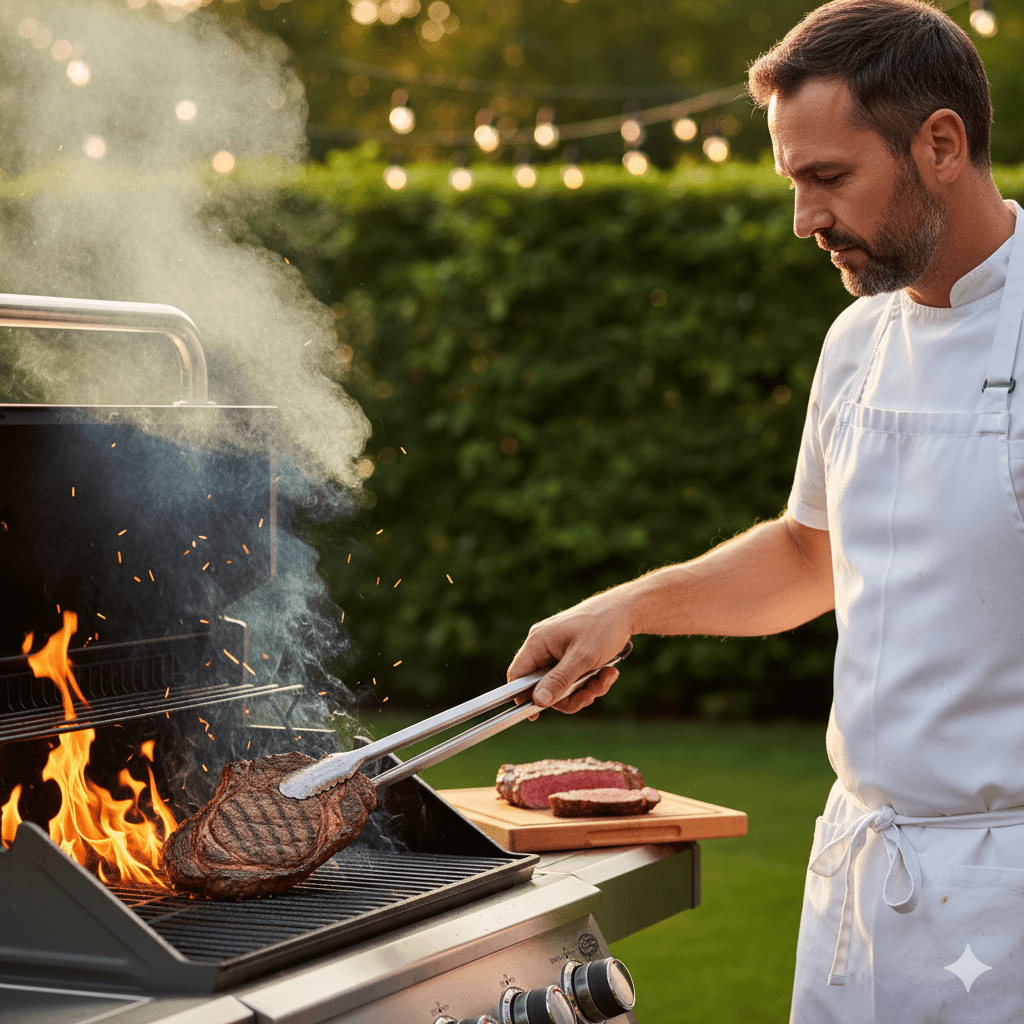
For perfect steak, your grill should be between 450°F and 500°F for most cuts. This high heat creates the delicious seared crust while keeping the inside juicy and flavorful. Different steak cuts and desired doneness levels may require slight temperature adjustments, which we’ll cover in this comprehensive guide.

Essential Tools for Perfect Steak Grilling
Before diving into temperatures, let’s make sure you have the right equipment. These tools will help you maintain proper heat and achieve steakhouse-quality results every time.
Must-Have Grilling Tools
- Grill surface thermometer (to measure actual grate temperature)
- Instant-read meat thermometer (for checking internal doneness)
- Long-handled tongs (for safe flipping)
- Timer or stopwatch (for precise cooking times)
- Chimney starter (for charcoal grills)
- Heat-resistant grilling gloves
- Grill brush for clean grates

Recommended: ThermoPro TP19H Instant Read Meat Thermometer
For perfectly grilled steaks, you need precise temperature readings. The ThermoPro TP19H gives you accurate readings in just 2-3 seconds, is waterproof, and has a backlit display for night grilling.
Grilling Safety Notes
Working with high-heat grilling requires proper safety precautions to prevent accidents and ensure a pleasant cooking experience.
Important Safety Reminders
- Never leave a hot grill unattended
- Keep a fire extinguisher nearby
- Ensure proper ventilation when grilling
- Use long-handled tools to avoid burns
- Keep the grill at least 10 feet from structures
- Clean grates regularly to prevent flare-ups

The Perfect Grill Temperature for Steak
The ideal grill temperature depends on your steak’s thickness, cut, and desired doneness. Here’s a comprehensive breakdown to help you achieve perfect results every time.
| Steak Cut | Thickness | Ideal Grill Temperature | Cooking Method |
| Ribeye, NY Strip, T-bone | 1-1.5 inches | 450-500°F | Direct heat |
| Filet Mignon | 1.5-2 inches | 450°F | Direct heat |
| Flank, Skirt, Hanger | 0.5-1 inch | 500-550°F | Direct heat, quick sear |
| Tomahawk, Thick Ribeye | 2+ inches | 225-250°F then 450-500°F | Reverse sear |
Internal Temperature Guide for Doneness
Remember that steak continues cooking after being removed from the grill. Pull your steak about 5°F before your target temperature to account for carryover cooking.
| Doneness | Pull Temperature | Final Temperature | Center Appearance |
| Rare | 115-120°F | 120-125°F | Cool red center |
| Medium Rare | 125-130°F | 130-135°F | Warm red center |
| Medium | 135-140°F | 140-145°F | Warm pink center |
| Medium Well | 145-150°F | 150-155°F | Slightly pink center |
| Well Done | 155-160°F | 160-165°F | Little to no pink |

Recommended: Weber iGrill 2 Bluetooth Thermometer
Never guess about doneness again. The Weber iGrill 2 connects to your smartphone and alerts you when your steak reaches the perfect temperature. Monitor up to four cuts simultaneously for perfect results every time.
How Different Grill Types Affect Temperature
Each type of grill has unique characteristics that affect how you’ll achieve and maintain the ideal temperature for steak.
Charcoal Grills

For charcoal grills, create a two-zone fire with coals piled on one side. The hot zone should reach 450-500°F for searing, while the cooler zone provides temperature control. Use a chimney starter for even heating and add more coals as needed to maintain temperature.
Gas Grills

Gas grills offer precise temperature control. Preheat with all burners on high for 10-15 minutes to reach 450-500°F. Create temperature zones by leaving some burners on high and others on medium or low. Always check the actual grate temperature with a surface thermometer.
Pellet Grills

Pellet grills combine convenience with flavor. Set the temperature to 450-500°F and allow 15-20 minutes to fully preheat. For thicker steaks, consider the reverse sear method by starting at 225°F and finishing at 450°F for perfect edge-to-edge doneness.
“I ruined my first ribeye by using a cold grill. Now I always preheat for at least 15 minutes and verify the temperature with a surface thermometer before the steak touches the grates. Game-changer!”
Step-by-Step Guide to Grilling the Perfect Steak
Follow these precise steps to achieve steakhouse-quality results using the ideal grill temperature.
- Prepare the steak: Remove your steak from the refrigerator 30-45 minutes before grilling to bring it to room temperature. Pat dry with paper towels to promote better searing.
- Season generously: Season with salt and pepper or your favorite steak rub. Apply oil to the steak, not the grill grates, to prevent sticking and flare-ups.
- Preheat the grill properly: Heat your grill to 450-500°F. For charcoal grills, create a two-zone fire. For gas grills, set burners to high. Allow 10-15 minutes for complete preheating.
- Clean and oil grates: Brush grill grates clean and oil lightly using a folded paper towel dipped in high-heat oil and held with tongs.
- Sear the steak: Place steak on the hottest part of the grill. Sear for 2-3 minutes without moving to develop grill marks and crust.
- Flip and continue cooking: Flip once and cook for the appropriate time based on thickness and desired doneness (refer to our temperature chart).
- Check temperature: Use an instant-read thermometer inserted into the thickest part to verify doneness. Pull the steak 5°F before your target temperature.
- Rest properly: Transfer to a plate and let rest for 5-10 minutes to allow juices to redistribute throughout the meat.
- Slice against the grain: For maximum tenderness, slice perpendicular to the muscle fibers.

Common Steak Grilling Mistakes and How to Fix Them
Even experienced grillers make these mistakes. Learn how to avoid them for consistently perfect steaks.
Temperature-Related Mistakes
- Not preheating enough: Always preheat for at least 15 minutes to reach proper temperature.
- Cooking cold steak: Let steak reach room temperature before grilling to ensure even cooking.
- Guessing doneness: Use a reliable meat thermometer instead of cutting into the steak.
- Skipping the rest period: Always let steak rest 5-10 minutes to redistribute juices.
- Frequent lid opening: This causes temperature fluctuations. Keep the lid closed as much as possible.
Technique-Related Mistakes
- Constant flipping: Flip only once for better crust development.
- Pressing down on steak: This squeezes out juices. Never press with spatula.
- Dirty grill grates: Clean grates before cooking for better sear and flavor.
- Wrong heat zone: Match steak thickness to appropriate heat zone.
- Improper seasoning timing: Season just before grilling for best results.

Troubleshooting Grill Temperature Issues
Having trouble maintaining the right temperature? Here’s how to diagnose and fix common problems.
| Problem | Possible Causes | Solution |
| Grill won’t reach 450°F | Low fuel, air vents closed, weather conditions | Add more charcoal/wood, open vents fully, shield from wind |
| Temperature fluctuations | Frequent lid opening, uneven charcoal, wind | Keep lid closed, arrange coals evenly, use windbreaks |
| Too hot/frequent flare-ups | Too much fat dripping, vents too open | Trim excess fat, partially close vents, create cool zone |
| Uneven cooking | Hot spots, uneven coal distribution | Rotate steaks, redistribute coals, use heat diffuser |
| Grill cools too quickly | Insufficient fuel, poor insulation, cold weather | Add more fuel, keep lid closed, preheat longer |
Recommended: GrillGrate Searing System
Struggling with uneven heat or inadequate searing? GrillGrates replace your existing grates to amplify heat, prevent flare-ups, and create perfect sear marks every time.
Frequently Asked Questions
Answers to common questions about grill temperatures for steak.
How long should I preheat my grill before cooking steak?
For gas grills, preheat for 10-15 minutes. For charcoal grills, wait until the coals are covered with white ash, typically 20-30 minutes after lighting. Always verify the temperature with a grill surface thermometer before cooking.
Should I close the grill lid when cooking steak?
For steaks under 1 inch thick, you can leave the lid open. For thicker steaks, close the lid to create an oven-like environment that cooks the steak through. Opening the lid too frequently will cause temperature fluctuations.
How can I tell if my grill is hot enough without a thermometer?
Use the hand test: hold your palm about 5 inches above the grill grate. If you can only keep it there for 2-3 seconds before pulling away, the temperature is approximately 450-500°F, perfect for steak. However, a grill surface thermometer is always more accurate.
Why is my steak burning on the outside but raw inside?
Your grill is likely too hot or you’re using only direct heat. For thicker steaks, use the two-zone method: sear over high heat (450-500°F) then move to medium heat (350-375°F) to finish cooking without burning. Also ensure your steak has reached room temperature before grilling.
How long should I let my steak rest after grilling?
Let your steak rest for 5-10 minutes after grilling. For thicker cuts, rest for the longer end of that range. This allows juices to redistribute throughout the meat instead of running out when cut, resulting in a juicier steak.

Pro Tips for Steak Grilling Success
These expert tips will elevate your steak grilling game to professional levels.

- Use the touch test: With practice, you can gauge doneness by touch. Rare feels like the base of your thumb, medium rare like your chin, medium like the tip of your nose, and well-done like your forehead.
- Try the reverse sear method: For thick steaks, start at 225°F until internal temperature reaches 115°F, then sear at 500°F for perfect edge-to-edge doneness.
- Add wood chips: For gas grills, use a smoker box with wood chips to add flavor. Hickory and oak pair wonderfully with beef.
- Butter basting: In the final minute of cooking, add herb butter to enhance flavor and create a beautiful finish.
- Invest in quality meat: Prime or Choice grade steaks have better marbling and flavor, making them more forgiving when grilling.
Temperature Mastery Tip
I’ve found that the most reliable way to maintain perfect grill temperature is using both a surface thermometer and an ambient temperature gauge. The surface reading tells you exactly how hot your grates are (where the steak touches), while the ambient reading helps you manage the overall cooking environment. This dual approach has transformed my grilling results.
Mastering Steak Grill Temperature
The perfect steak starts with the right temperature. By maintaining your grill at 450-500°F for most cuts, you’ll create that restaurant-quality sear while preserving the juicy interior that makes steak so satisfying. Remember that different cuts and thicknesses may require adjustments, but with the guidelines in this article, you’re well-equipped to grill perfect steaks every time.
Don’t forget that quality tools make a significant difference in your results. A reliable thermometer is perhaps the most important investment you can make for consistently perfect steaks. Happy grilling!
Essential Grilling Kit for Perfect Steaks
Take your steak grilling to the next level with our recommended tools bundle. Includes a premium instant-read thermometer, grill surface thermometer, and professional-grade tongs.
